

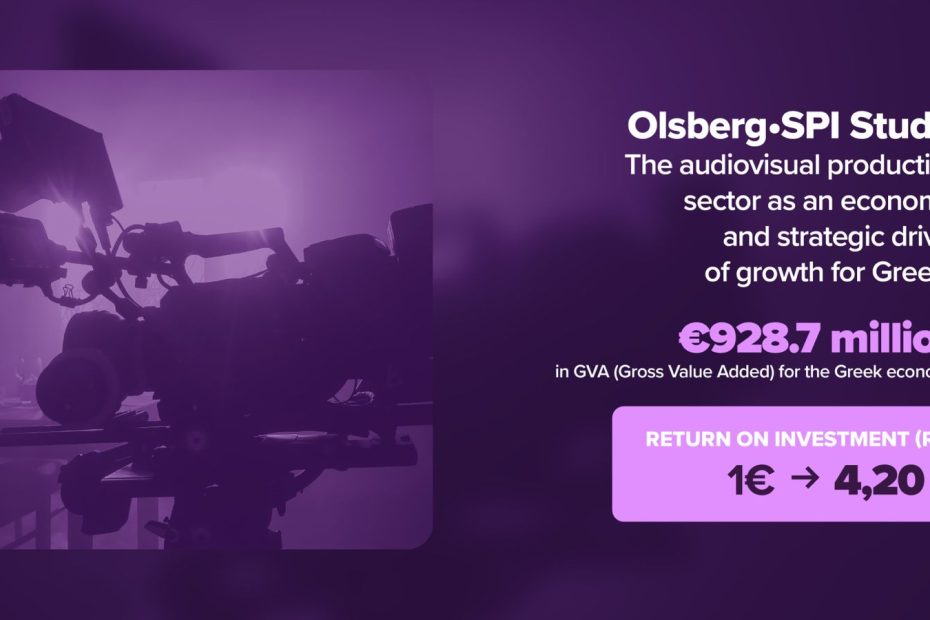
A new economic impact study by the international consulting company Olsberg•SPI (“SPI”), presented to Greece’s Ministry of Culture and EKKOMED, confirms the crucial role of the Greek production incentive program for the country’s economy. According to the findings, during the period 2018–2025, the Greek cash rebate produced an impressive economic return on investment (ROI) of 4.2, creating significant added value and thousands of jobs.
Main findings of the study – economy-wide impact
- Every €1 of public investment in the cash rebate generated €4.2 of net gross value added (GVA)
- An average of 2,900 full-time equivalent (FTE) jobs were created annually
- The total economic benefit for the Greek economy amounted to €928.7 million in GVA
- The Greek cash rebate is a key catalyst for attracting international productions
The study was conducted between April and October 2025, on the basis of data collected by EKKOMED, as well as interviews with a wide range of stakeholders, including policymakers and representatives of the Greek and international film and television production sectors. In preparing the study, SPI collaborated with the Foundation for Economic & Industrial Research (IOBE), which peer-reviewed SPI’s methodology and results.
SPI, a leading screen sector consultancy with extensive international experience in the sector, undertook the study to assess the economic impact of Greece’s film and television production incentive program. SPI has undertaken significant analyses of incentive programs for a range of European countries, including Spain, the United Kingdom and Ireland, as well as countries around the world, including Australia and New Zealand, and several U.S. states.
The study has been commissioned by Oxbelly AMKE, a Greek non-profit organisation founded by Christos V. Konstantakopoulos that supports the creative and economic development of the Greek audiovisual sector.
The study confirms that the Greek film and television production sector:
- is a strategic sector that has a significant economic impact on Greece
- strengthens innovation and technological specialisation
- attracts significant international investments
- promotes Greece’s brand internationally, overall but also as a tourist destination.
According to data received from EKKOMED at the time of the study, around 291 national and international projects were paid through the cash rebate program since it began receiving applications in 2018, while around €205.4 million had been disbursed through the program since 2019.
SPI’s economic impact analysis is based on data received from EKKOMED on over 400 projects that were either funded or approved for the cash rebate. The results of the study show that the cash rebate has substantially strengthened the film and television production sector in Greece, which now has a very strong foundation to further develop and continue to support the Greek economy. The study finds that there is an opportunity for Greece to scale up and become a more developed production hub, which is dependent on the long-term presence and stability of the incentive on a multi-year basis.
The SPI study, acknowledging the positive impact of the program as well as the prospects of the sector, includes a series of proposals for the further development of the sector in Greece, such as:
- The ongoing and stable financing of the cash rebate by the State over time, in order to strengthen confidence in the Greek market by investors in production and sector infrastructure
- The simplification and acceleration of the procedures and the strengthening of the international competitiveness of the program.
In parallel, the study emphasises the need to strengthen the sector as a whole, through:
- Enhancing the development of production infrastructure
- Strengthening of the Greek production sector, given the critical importance of national production in the overall ecosystem
- Investing in human resources, skills development and vocational training programs.
Note: the economy-wide figures presented above include direct, indirect, and induced impacts; the period 2018-2025 does not reflect all activity in 2025 so the annual impact for this year is likely to be larger.
Statement by the Minister of Culture Mrs Lina Mendoni:
“The Olsberg study confirms in the clearest way that Greece must continue to invest strategically in the audiovisual sector. It is a high-tech, highly creative and highly efficient sector that supports the economy, boosts employment and promotes the country internationally.”
“The Olsberg•SPI study demonstrates clearly and provides strong evidence that audiovisual production is a dynamic growth sector. And in this case, Culture is proven to be directly directly linked to the Economy. A similar study on the impact of investments in the cultural heritage sector has shown that €1 public investment creates €3.44 of added value. This indicates that, overall, public investments in Culture yield higher returns than other sectors, such as tourism. Over the last years, Greece has proven that it can host and support demanding international productions, while at the same time activating the domestic services market and boosting employment.”
Statement by the Deputy Minister of Culture:
“This study confirms of the soundness of the Government’s choice for strategic investment in the film and audiovisual sector. The methodical work by the Ministry of Culture, as well as the institutional and substantial consolidation of EKKOMED, find us ready to move to the next level for the creation of an integrated creative and development ecosystem for the film and audiovisual sector.”
Statement by Leonidas Christopoulos, CEO ΕΚΚΟΜΕΔ
“The results of the study leave no room for doubt. The audiovisual creative sector is one of the most efficient productive sectors in Greece. As EKKOMED, we are organising this dynamic, investing in the new generation of creators and building a modern ecosystem that can place the country on the international creative map.”
Statement by Leon Forde, CEO Olsberg•SPI
“The study indicates that Greece’s film and television production sector has seen remarkable development, having received a significant boost from the cash rebate program in recent years. By securing stability and long-term commitment, and with the right support from all stakeholders, Greece has the potential to further develop as a leading production hub, to the benefit of both the national production sector and the country’s economy.”
Press Release here